
‘It should be fine, as long as I don’t lick it…”

Some visual refections, on the Post-extractivist landscapes and legacies conforence I attended in July in University Collage Dublin, Irleland
We spent the day out of the city at the end of the three-day ‘post-extractivist landscapes and legacies conference’ in Dublin. After a morning at the Abbeyleix bog, the afternoon was spent at what remains of Glendalough, lead mine. This section of ancient landscape bleached white, where neither moss nor fern would grow. It is a landscape of schist and white quartzite baring mineral fragments, with its own beauty. In collecting a stone, I was asked if I thought it wise. My response,”it should be fine, as long as I don’t lick it.” brought home some ideas I’d been pondering on as the conference speakers, each related their work. Themes of bodies, residues, and vague terrains repeatedly entered the conversations. Reflecting on particulate issues, dust, and the need to empty extractive zones of meaning to facilitate extractive acts appeared to contrast the lived experience and earth knowledge of inhabitants and researchers who live and work within extractive landscapes.
In this and a previous conference trip to Helsinki in December 2022, my mind has been on the particulates of extraction, that which we cannot see, that which we breathe in, that which is captured in snow piles and accumulates on the surfaces of our cities, and homes. Over the past months in my home city, Johannesburg, I have watched as the vast mine tailings to the south of the city have been eaten away for re-mining, and I struggled to breathe as air quality worsened, the wind scattering fine particulates into the atmosphere. These moments have led me to begin an artistic reflection on the relationship between bodies, cities, and extractive particulates, which traverse contexts and stray out of bounds. It was the naturalist Alfred Russel Wallace who, in his essay on the importance of dust in 1898, first described dust as “matter in the wrong place“[1] noting that “whatever injurious or disagreeable effects it produces are largely due to our own dealings with nature[2]“, yet in his essay he also reflects, that dust is also necessary for life, creating many of the phenomena, we find most beautiful, blue Irish skies, Johannesburg’s fiery sunsets, and the mists clouds, rains, and snow vital for sustaining life on the earth. In his essay, Wallace illustrates the complex relationship between dust, which gives life, and conversely, extractions and eruptions, which alter climates and affect the earth’s capacity to sustain life. Dust is familiar to us, homely, yet dust is the accumulative, climate-altering particulate of extractions and extractive zones, which blow upon the winds, traverse beyond the immediate zones, and travel across borders and continents.
[1] Wallace, ‘The Importance of Dust: A Source of Beauty and Essential to Life (1898)’, 69.
[2] Wallace, 69.
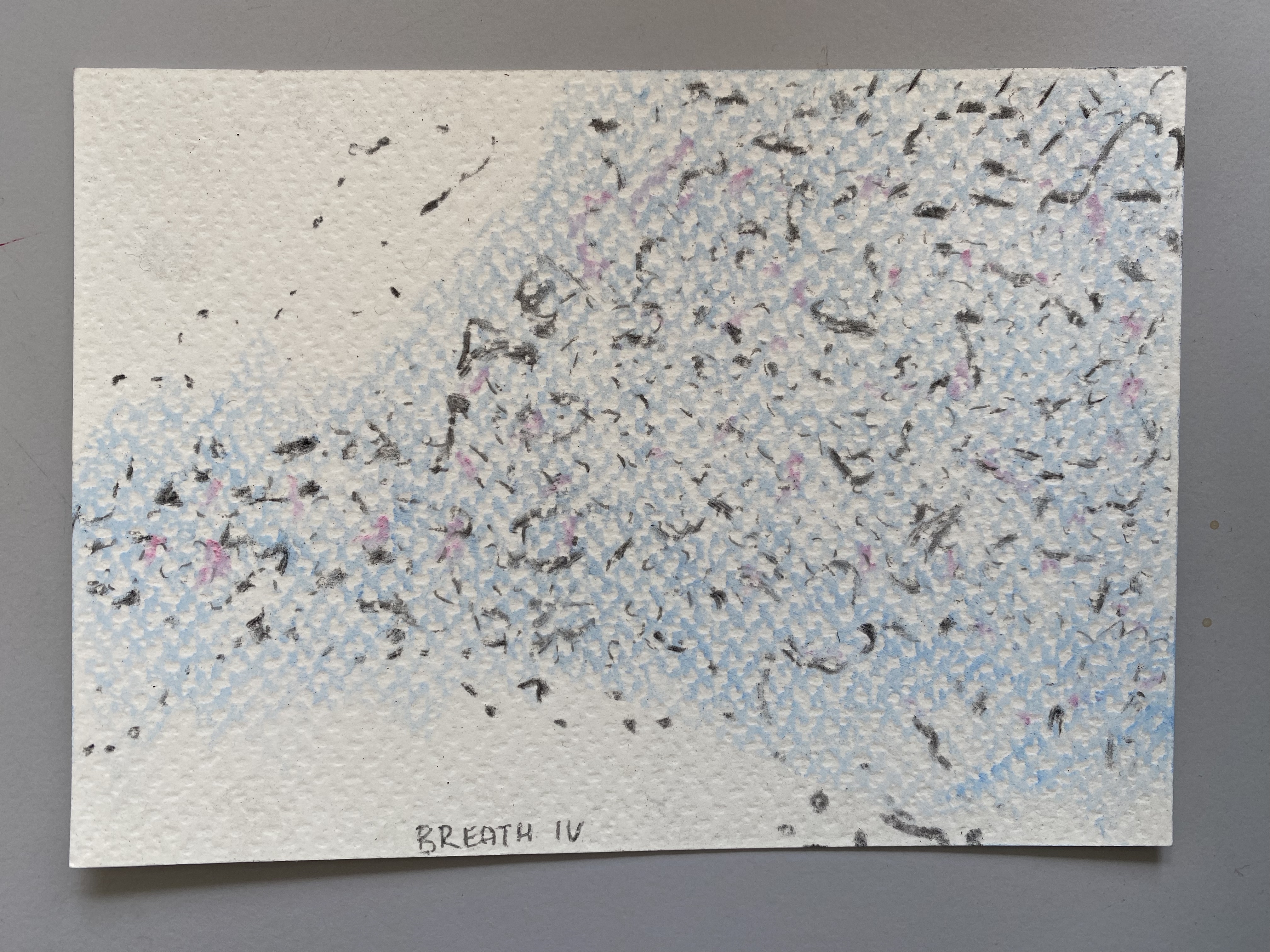
Naturally, that is one of the critical issues of life in extractive zones, that fine particulate that clings, that humans, animals and more than humans, who live in extractive and post-extractive terrains, breathe in, touch and lick. Perhaps one of the most complex stories to tell of the interactions of extraction-driven climate change is the weaving of the effect of extractive particulate to the body. This geological scale to the everyday lives of those who breathe it in. Throughout the conference, my written reflections turned to extractive matter and particulates that we lick, which enter the bodies and alter them to the trouble of drawing breath in the extractive zone. Below are the series of note sketches produced over those conference days and since, which attempt to explore particulates, atmospheres and breath. That attempts to relate the bodies and beings who dwell within these zones to particulates breathed in and particulates of extractive terrains. Breath I, and Breath Relations contemplates the depth and height of the extractive zone. Breath II – contemplates what it means to be breathing downwind of extractive mining zones. breath III, IV + V) contemplate breath as a way of materialising extractive matter.


[1] Wallace, ‘The Importance of Dust: A Source of Beauty and Essential to Life (1898)’, 69.
[2] Wallace, 69.
Leave a Reply